What’s happening in Rojava this week and how we can support the resistance.
The Democratic Autonomous Administration of North and East Syria (DAANES) continues to be under attack from the Syrian Transitional Government (STG) and its people are continuing to mobilise, while around the world there is insufficient, but increasing, attention being paid to the gravity of the situation. Crucially, despite the 15-day ceasefire being repeatedly broken by the STG, a landmark agreement has been reached between the Syrian Democratic Forces (SDF) and the STG. Meanwhile, there have been demonstrations worldwide, two European solidarity caravans, a swathe of solidarity statements and, in the UK, a reignition of the trades union-focussed Kurdistan Solidarity Campaign.
You can read all of our previous updates here.
Syria/Rojava
Military Update
Under the new agreement, SDF and STG troops are to withdraw from the current frontlines to pre-agreed barracks.
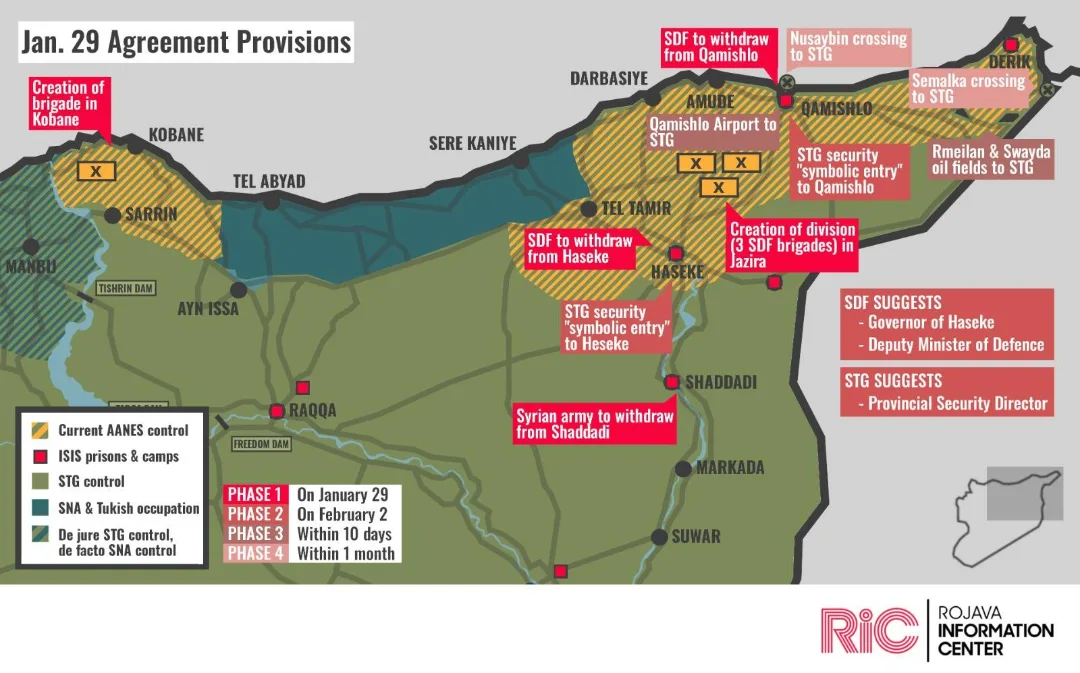
From what we can tell, the withdrawals have partially happened, but Kobane has remains under siege (for now going on 14 days). The STG has taken prisoners of war (POWs), subjecting them to torture and executing around 30, with reports of burning their corpses afterwards. STG fighters have also been documented desecrating SDF graves and “promising” some (women) POWs to superior officers as gifts. Reports of rape are commonplace.
Meanwhile, US armoured vehicles have been seen to the south of Heseke, and Kurds from across Kurdistan and the world continue to risk their lives and travel to Rojava to join the popular defence forces, slipping across several of the most heavily-militarised borders in the world to do so.
Humanitarian Update
Vitally-needed aid trucks had been held at the Turkish border for days, as children died of exposure. Turkey continues to detain the convoy ‘loaded with water, baby food, clothing, and other essential supplies’. The community has no electricity, food, water or Internet, but as of this morning a 20-vehicle convoy of STG forces entered the city.
As of 27 Jan, the UN put the number of internally displaced people (IDPs) across Rojava at 170,000. Many people are in danger, and some have been killed.
Civilians are also being killed, either being caught up in clashes with insurgents and/or tribal cells in Haseke, Raqqa and Tel Barak, or passing over leftover landmines in areas like Tishreen. The number currently stands at around 100 in total, with reports showing double the number of people killed by STG.
On the ground, local people continue to arm themselves and demonstrate their commitment to the emancipatory gains of the DAANES. Women in particular know that the threat to their freedom—their very lives—is severe, and many are organising themselves to defend their communities. This does not only mean taking up arms: everyone in the community is involved in self defence, and all contributions are seen as equally valuable:
Armed Mother and Children in Kobani
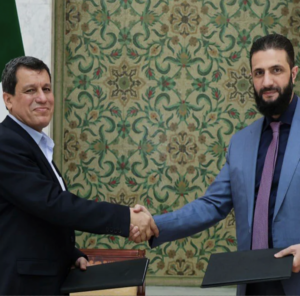
SDF–STG Agreement
So, what does this new agreement mean? The truth is that nobody knows. There are some reasons to be optimistic, and many reasons to be doubtful. Several previous deals have been breached by the STG, which also has limited control over many of the Turkish-backed jihadist gangs that make up its ‘army’ (as seen in previous massacres in Latakia and Suweyda). Integration into the Syrian state and armed forces will bring intense pressure on the revolutionary structures to adopt statist logic and to abandon their liberatory principles.
The gains of the revolution are not secure, but that, in itself, is no change from the status quo (and is probably never going to be the case). The revolution has had to fight against incredible odds, every day of its existence so far, whether against the slavers of ISIS, the fascists of Turkey or the Islamists of the so-called STG. And, of course, against its own internal contradictions and shortcomings.
The deal is controversial among the community, with many feeling disappointed and concerned that it leaves much room for interpretation and exploitation:
There is a general atmosphere of confusion and uncertainty in society about how things will develop.
Most people’s responses to the question of what they think about the agreement sound something like this:
“I don’t know, we’ll see, but we are prepared to defend our values and achievements if necessary.”
Especially the women are making their stance very clear these days through demonstrations and public statements:
“We tell the world that we Kurds will never submit; we will always resist. Our main motto is: ‘Berxwedan jiyane.'” says Şukriye Osman at a demonstration in Qamishli.—Women Defend Rojava
But, assuming the deal does hold, we must be clear-eyed about what has been avoided here: previous massacres in the ‘new’ Syria have seen thousands killed, largely along ethnic and sectarian lines, and there was a very real chance we were about to see the same again here. As internationalist leftists, the events we most often valorise tend to be heroic last stands and past struggles that were violently crushed: Catalonia, the Paris Commune, the Maknovschina, and so on. We do not remember these only in memoriam, or because of the inspiring power of their liberatory visions, or as hard lessons to be learnt for next time: we remember them so fondly because of the infinite possibility of what could have been.
For a contemporary struggle such as Rojava—a story whose ending remains unknown and unwritten—we must stand in solidarity with it whilst acknowledging that in the messy real world, compromises must be made in the interests of survival. The people of North & East Syria—and of Syria as a whole—have surely earned the right to some sort of peace, however tenuous it may be, and we must sincerely hope that this deal leads to it, for their sakes.
But just as al-Sharaa of Syria (formerly al-Jolani of al-Qaeda) now wears a suit and hobknobs with foreign leaders, but remains an fundamentalist authoritarian butcher at heart, so we must hope that the outward trappings of state legitimacy will do nothing to dampen the revolutionary fire that has been burning in North & East Syria for so long, and that whatever might happen at the source, the flames have risen too high and spread too widely to ever be extinguished again.
Iran/Rojhilat
The Iranian regime’s brutal crackdown on recent protests has been particularly intense in minority areas like the Kurdish and Balochi regions. The Kurdish Human Rights Action Group (KHRAG) have released the names of 163 Kurdish civilians killed by security forces so far. It has been reported that more than 6,000 people were killed and over 49,000 protesters were detained across Rojhilat and Iran since the late-December protests began. As videos continue to surface of the atrocities committed under the veil of an internet shutdown, the appetite for sustained and meaningful change across Iran prevails. We hope that this resistance will pave the way for increased organisation, diplomacy and visibility towards ethnic and cultural rights for the Rojhelati Kurds.
Global solidarity
International awareness and support continues to rise, with an explosion of social media coverage and solidarity statements coming in from Indonesia to Chile. The campaigns Women Defend Rojava and RiseUp4Rojava declared “Global Action Days in Defense of Rojava” from January 25 to February 2. In total, 242 organizations and 113 individuals from 45 countries—including well known voices like Greta Thunberg and Raúl Zibechi—signed the call.
This huge international mobilisation has had a significant effect in bringing STG to the ceasefire table. Mazlum Abdi of the SDF General Command also emphasised how international solidarity has enormously strengthened morale among forces and communities across the region.
The People’s Caravan
In particular, over the last two weeks, a convoy of 100 young people from across Europe called the ‘Caravan in Defence of Humanity’ has been travelling to Rojava. The caravan involved Jenny Keasden, Patrick Thelwell and Skylar Sharples from the UK, among others.
Just as the Freedom Flotilla set off from Italy to attempt to break the Israeli siege of Gaza and deliver humanitarian aid, we have travelled across more than seven borders—by land and air—to break the media silence over the atrocities being carried out in the region, and in particular the role of the UK and EU in propping up the fascist Turkish state, selling them advanced weaponry that is used to carry out massacres of Kurdish people. Furthermore, our governments have played a shameful role in rehabilitating former al-Qaeda leader al-Jolani as a legitimate democratic head of state.
—Patrick Thelwell, UK People’s Caravan participant
Patrick and Skylar were stopped near the Turkey–Syria border in Suruç, detained by Turkish police and violently beaten before being deported to Vienna. Read their press release here.
Despite many being detained and deported, 13 people from Germany and Switzerland—including politicians, artists and human rights activists—finally made it to Rojava to report on the situation, and we await their reports from the ground.
Follow the People’s Caravan for more info.
Political Efforts
As the world slowly starts to take notice of the situation, US Senator Lindsey Graham announced the ‘Save the Kurds’ Act involving sanctions on hostile actors in Rojava. In a public statement, Graham acknowledged that the STG are aligned with Turkey, emphasised the Kurds’ key role in destroying the ISIS caliphate and added that ‘it would be a disaster for America’s reputation and national security interests to abandon the Kurds’.
Whilst we know the fickle and untrustworthy mood of the US, and the general fragility of Western pledges to stand by the Kurds over the course of history (see here), it is important to have a bright light shone on the situation in this way, at this moment. Graham’s statement joins a number of governmental figures and bodies expressing solidarity with the Kurds, which you can find on our statements page, as well as formal efforts within various political systems which you can find here.
Meanwhile, friends from the KSN have been working hard to relaunch the UK trades unions-focussed Kurdistan Solidarity Campaign (KSC). Working with friends and comrades from sister campaigns and organisations, the KSC’s aim is to build solidarity across the labour movement for freedom, justice and self-determination across Kurdistan, putting into practice worker traditions of progressive internationalism. So far, the KSC has been developing motion templates (see below) for workers to bring to their branches, and co-signed a letter to UK Prime Minister Keir Starmer.
If you want to support the KSC, you can do so in the following ways:
- ⚒️ Pass our motion in your union, cooperative or related civil society organisation
- ⚒️ Let us know when you’re submitting through this form
- ⚒️ Follow the #WorkersDefendRojava info & join the announcements chat to stay up to date
- ⚒️ Get in touch at general@kurdistansolidaritycampaign.info
How to Take Action
The region needs your support more than ever, and there are a number of ways you can help build awareness, raise funds, and organise support. The intense global pressure over the last few weeks, paired with the society-wide mobilisation and fierce resistance in Rojava, is what forced the Syrian regime to agree to this deal; we must maintain the pressure to ensure that they stick to it, and to transform the incredible surge of energy that we saw in January into a sustainable, powerful ongoing movement.
- Tools, Resources and Visuals for Organising
- Post any events or demos you are organising in the Defend Kurdistan UK WhatsApp group, or email hello@kurdistansolidarity.net so we can publicise and support
- Organise actions against arms companies and the businesses that drive the military-industrial complex!
- See a map of weapons factories in Britain that are supplying Turkey
- For an example event, see Stop Arming Genocide! Kick BAE Out of Sheffield
- Write to your MPs:
- Urge your MP to sign Early Day Motion 2664 on the Situation of Kurdish People in Syria
- Demand that they apply immediate political pressure to stop the attacks, end direct and indirect support for HTS, ISIS and Turkey’s actions in Syria, take a clear position against the ISIS threat, provide urgent humanitarian assistance and instigate international monitoring and accountability. And, crucially, that they work towards the political recognition of the Democratic Autonomous Administration of North and East Syria (DAANES) for a lasting solution. If you are uncertain how to write such a message yourself, you can use a pre-written template.
- If you have a Green, Your Party or Plaid Cymru MP, or are involved in in those parties (or other progressive parties), it is especially important that you engage with them as they have been more supportive, and their vocal support puts pressure on other MPs
- Organise film screenings of the Berxwedan Jiyane: The Resistance of Tishreen documentary and get in touch if you want us to help you find local speakers who can give some updates and calls to action at the screenings
- Fundraise for Tov Kurdish Aid (how to donate)
-
Other Fundraising
You could also fundraise for Kurdish Red Crescent (Heyva Sor) and Women’s Foundation (Waqfa Jin), but Tov is the recommended way to fundraise in the UK as these other two groups do not have UK bank accounts. However, the details are presented below:
- Kurdish Red Crescent
- Women’s Foundation (Waqfa Jin)
-
- Support the Peoples’ Caravan, people from all over Europe are travelling to Kobane to defend the revolution
How to keep track of what’s happening?
It can be really confusing to know what’s happening on the ground, and what it means. Most mainstream news sources (including Al-Jazeera) have a terrible track record in accurately reporting what’s happening in North and East Syria. We would recommend the following ways of following developments:
- Rojava Information Center (RIC), independent media group
- The Amargi, independent media group
- Jenni Keasden, journalist who is on the Caravan:
WhatsApp/Social Media Accounts to Follow
- Defend Kurdistan UK WhatsApp groups:
- WomenDefendRojava
- Women Defend Rojava UK group
- Central accounts:
- YouTube: Women Defend Rojava
- Instagram: @women_defend_rojava
- Facebook: Kongra-Star-Womens-movement
- Telegram Channel
- X/Twitter: WomenDefendRoj1
- RiseUp4Rojava
- Central accounts:
- Kolectiva.Media: @riseup4rojava
- Instagram: @riseup.4rojava
- Telegram Channel
- X/Twitter: @RISEUP4R0JAVA
- Central accounts:
- Syrian Democratic Forces:
- Twitter: @SDF_Syria
- YPG (Peoples’ Defence Units) and YPJ (Women’s Defence Units): @YpgInt
- Rojava Information Center (RIC):
- Mastodon: @RojavaIC
- Instagram: @rojavaic
- Facebook: Rojava-Information-Center
- X/Twitter: @RojavaIC
- Anha English: